Behind every successful college application
is a story that hasn't yet been told.
Most students have the "what," but they struggle with the "how." As an award-winning author, essay coach, and college consultant, I help students showcase who they are beyond their grades and transcripts. Together, we'll craft an application package that doesn't just list achievements, but reveals the human being behind them — the one admissions officers can't wait to meet.
I got started on this path when I was in your shoes
The more I learned, the more I realized I didn't know.
As a parent, helping my high schoolers decipher the college application process was stressful and confusing.
Independent Educational Consultants help students and parents think differently about what getting into a "good fit" college really means. It's not about ranking — it's about how your kiddo feels on that campus, in those classrooms, with those professors, classmates, teammates, dormmates. It's about whether each college on the list is a good fit for this particular student, socially, academically, and financially.
Finalist, Loudoun (VA) Chamber Small Business Entrepreneur of the Year, 2026
Named Washington Parent's Best College Consultant & Best Essay Coach, 2026
Graduate Certificate, College & Career Counseling, University of California, Berkeley, 2024
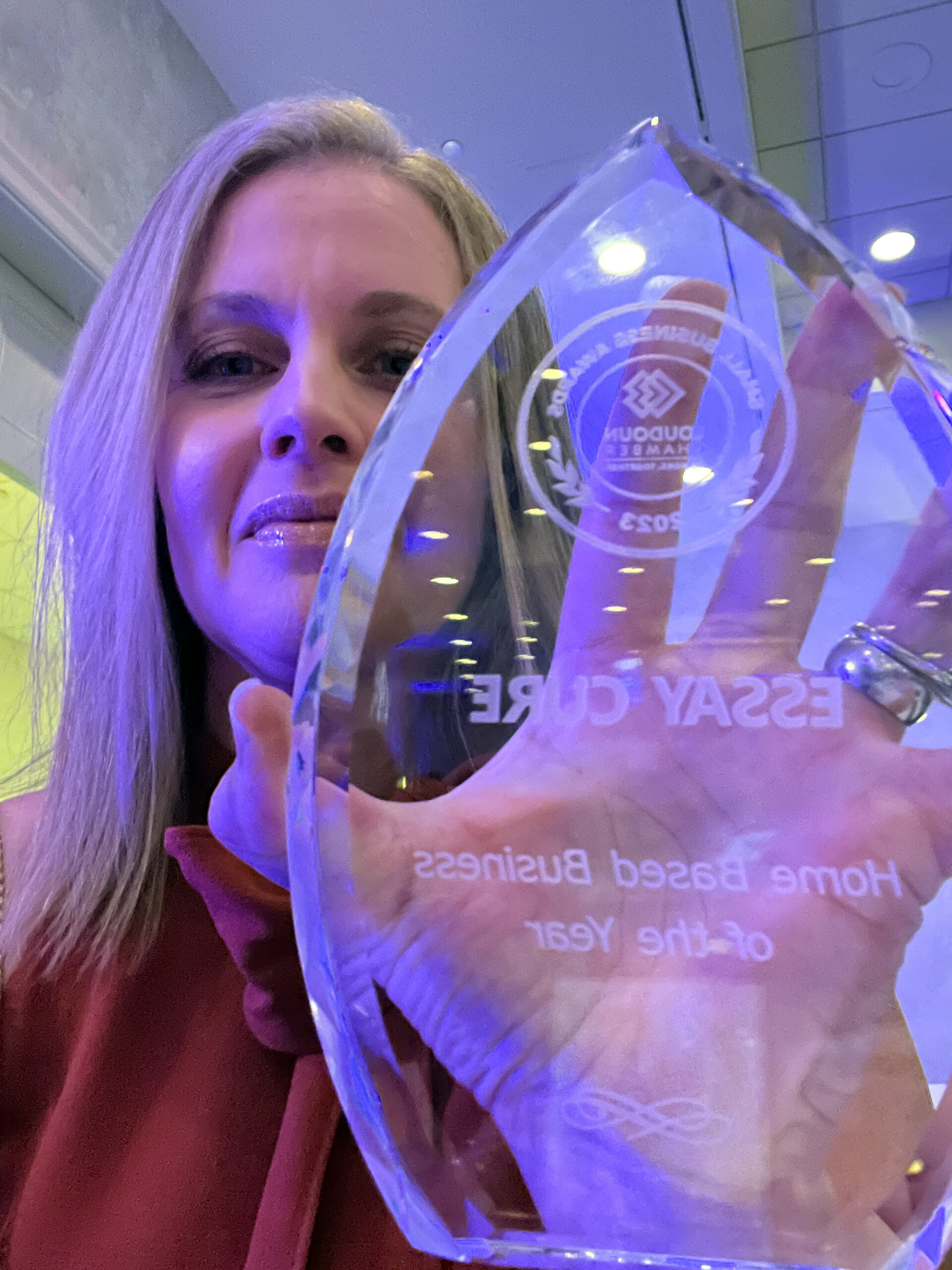
Winner, Loudoun (VA) Chamber of Commerce Small Business Award, 2023
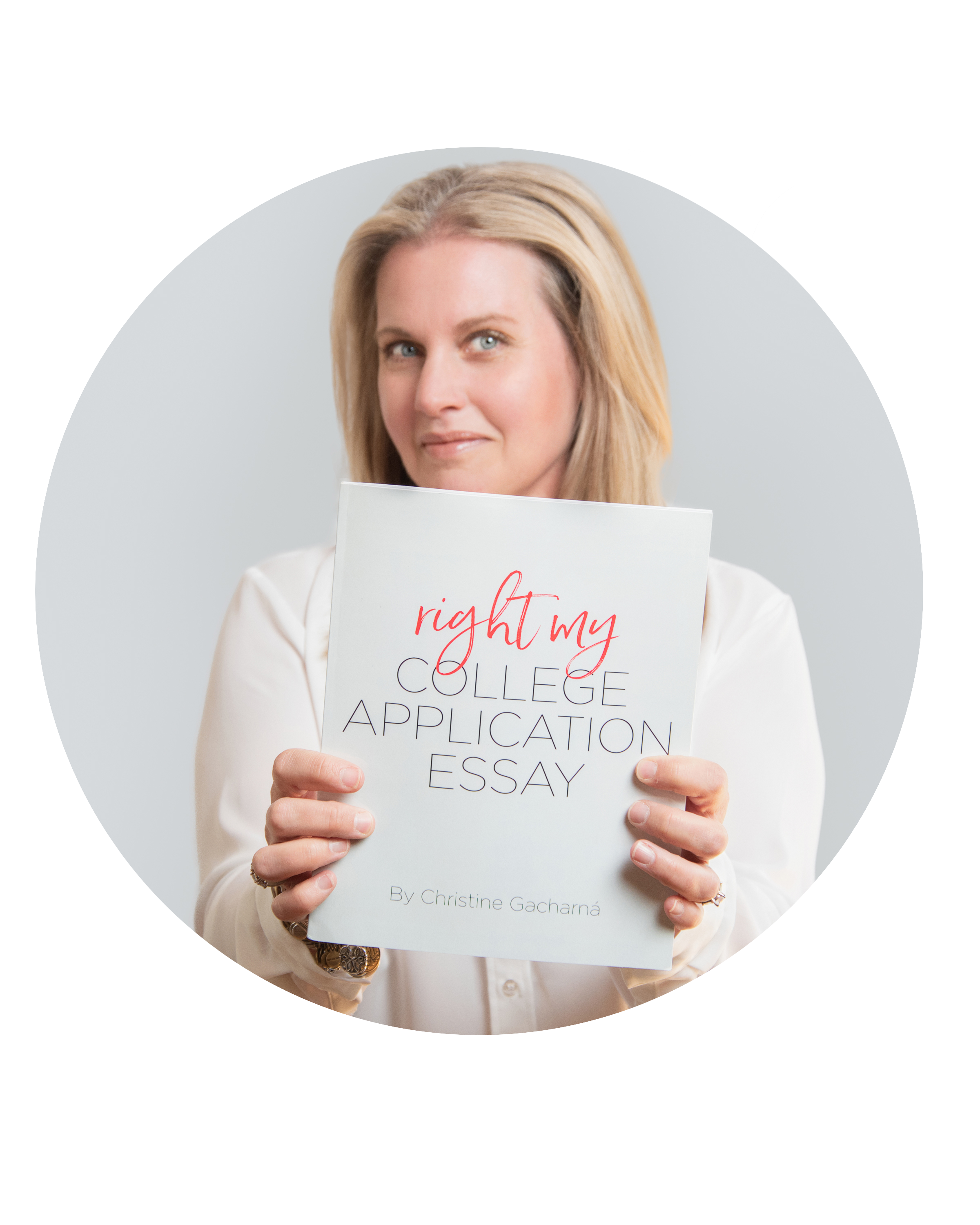
Author, RIGHT My College Application Essay, 2023
Creator & Managing Partner, ESSAY CURE, 2019
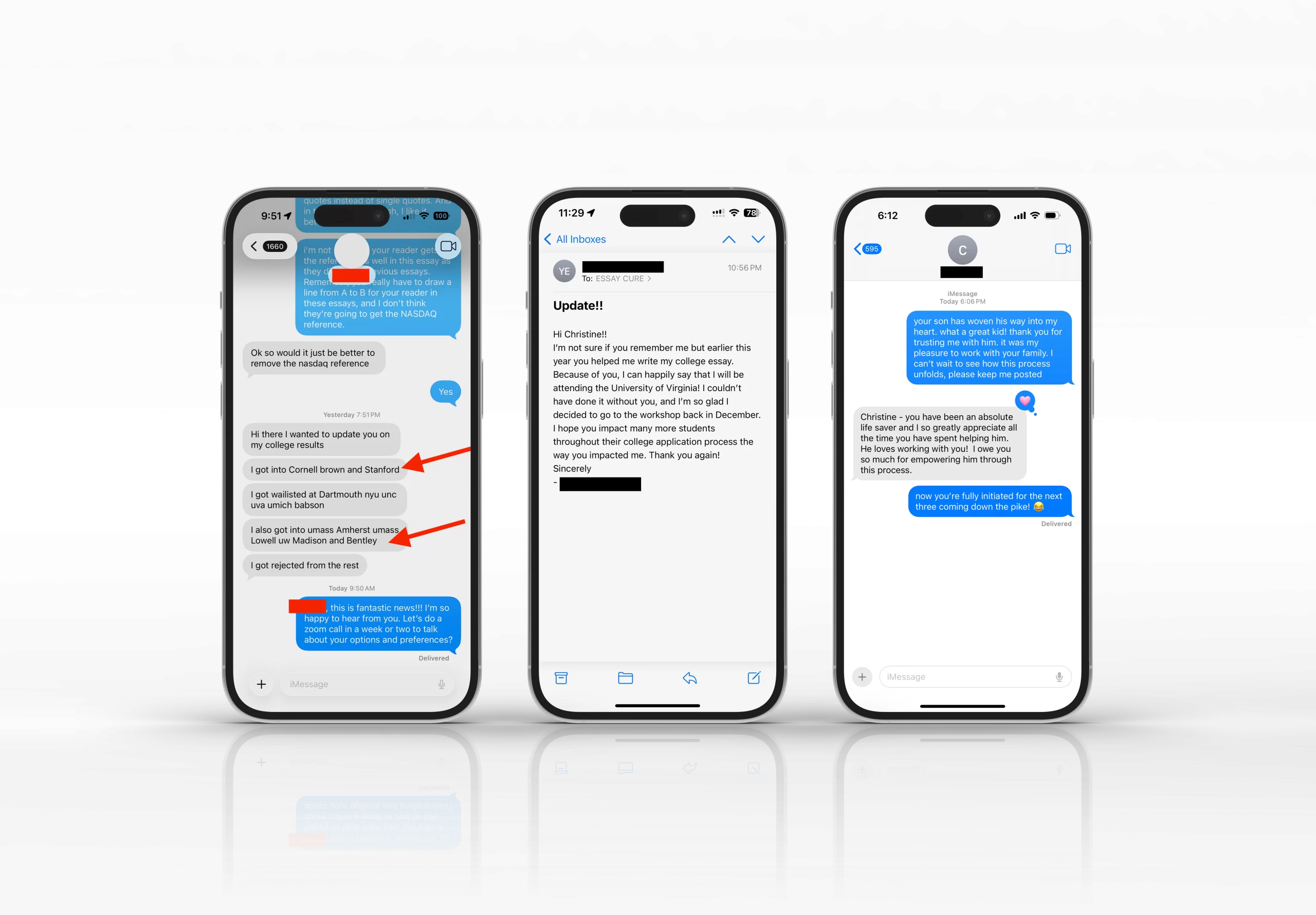
"Working with Christine is by far one of the best things I have done for my kids while getting ready for the college application process. I assumed she would help us with the college essay and maybe a few other things, but the guidance she has given us is so, so much more.
I would highly recommend working with Christine. It truly is a gift to your child."
– Theresa, parent









Hey there!
THIS IS MY STORY OF HOW I CAME TO BE THE COMPANY THAT HELPS STUDENTS WRITE THEIR STORY
For Elizabeth, writing her essay was The. Most. Daunting. task in her college application process.
For starters, high school teaches students how to write 5-point, “hamburger” essays, and in that kind of essay, first person isn’t allowed.
Elizabeth wasn’t quite sure how to write about “what she learned from her greatest failure” without using first person.
So Elizabeth did what most students do — she wrote a rough draft and then came to me asking if I would “edit” it.
I didn’t find any problems with noun/verb agreement or typos in Elizabeth’s essay — Elizabeth is a 4.0+ student. She knows how to WRITE.
Curiously, what I did find:
She spent 477 words writing an introduction.
In a college application essay that could only be 650 words MAX.
SEVENTY-THREE PERCENT of her essay was not even focused on answering the question posed by the prompt!
She made the first of “The FIVE Most Common Mistakes” students make when writing a college application essay.
What she needed was for us to show her how admissions officers read these essays backward, and that the formula for the college application essay isn’t the same formula students use in high school.
The college application doesn’t open with an introduction — it uses a completely different rhetorical mode.
Whoa, wait! What’s a “rhetorical mode”?
If you don’t know which rhetorical mode you should be using, let alone which organizational method to pair with it, you’re already at a disadvantage, letting your essay fall into a stack next to highly qualified applicants — never mind once class starts next fall.
ESSAY CURE bridges the gap between high school AP English Lit and undergraduate academic writing, starting with the college application essay. Our instruction guides students step-by-step with personalized instruction, building on what they already know to inspire them to RIGHT a college application essay that separates them from tens of thousands of applicants in an insanely competitive college application process.
Our students learn how to use these same techniques to succeed in college essay writing — because, college!
What if you get in?
My journey
MY AH-HA MOMENT CAME AS I WAS WORKING WITH A DOZEN OR SO HIGH SCHOOL STUDENTS ON THEIR COLLEGE APPLICATION ESSAYS.
Wait, let’s back up a bit.
At the time, I was an associate faculty member at the University of Phoenix teaching undergraduate COMM and English courses.
What I saw immediately was students falling back into the same bad habits that got them through high school—white-knuckling their way through their rough draft, just trying to get it over with —and that wasn’t going to fly at the undergraduate level.
See, the thing about UPOX is that there’s no Scantrons for exams; almost every assessment in every class is an academic essay, and there’s at least one a week.
When I would pull students aside, they could give me the answers I was asking for. They knew the material. And they knew how to write. But “testing” them with an academic essay brought up the muscle memory of frustration and bad habits. They simply didn’t have a foundation in academic writing.
They say there’s no better way to master an art than to teach it. That’s what happened to me in that job. I audited other classes, retraced my own learning, and pored over student essays to identify patterns and common mistakes. And then I rolled up my sleeves and got to work developing an effective way to teach the fundamentals of academic essay writing.
And it WORKED.
I showed my students how to use the steps in the writing process as a tool and how to let the tool do the work for them. I watched as their faces lit up with relief when I’d tell them they don’t have to write the Great American Novel — they don’t have to draw from the depths of their soul! It’s academic writing! Academic writing follows formulas. The steps in the writing process are the foundation for applying those formulas and, when used properly, make the writing the easy part.
My students were so successful, in fact, that it wasn’t long before I got promoted to Lead Faculty for Communications and was responsible for spearheading campuswide policy and efforts to streamline the evaluation and assessment of student writing.
Meanwhile,
I HAD TWO HIGH SCHOOLERS AT HOME,
a senior and a junior who was on track to graduate a year early, plus my friends’ kids and my kids’ friends —
Eventually, it dawned on all of them that they had a college writing instructor in their midst and before I knew it, I was knee-deep in reading college application essays.
As with my university students, I immediately saw the patterns: students clearly weren’t using the steps in the writing process. How could I tell? Well, the essays would begin and end at rough draft, for starters, and most were using the wrong rhetorical mode and organizational method, both tenets of academic writing at the undergraduate level.
That’s when I had my ah-ha moment.
voilà
In 2017, I created essaypalooza! to share my time and talents as a successful college writing instructor with teenagers looking to land acceptance letters from their dream college. essaypalooza! teaches students how to write a college application essay using the same techniques taught in undergraduate writing — because, COLLEGE. What if they get in?
I started approaching high school administrators, trying to get in front of high school juniors before they started writing their college application essays so that I could give them my crash course in academic writing before they made the mistakes they’d only have to go back later to correct. What I was told time and again was Wow, this is great, and it’s great what you’re doing for high school seniors and all, but what you’re talking about here is higher-level curriculum development, and what I’d really like is to get you in front of our 6th graders before they take their SOLs.
In 2020, I created ESSAY CURE to help students of all grade levels understand the framework for academic writing and to help teachers from all backgrounds use the steps in the writing process to create a solid foundation for effective communication that grows and develops with the student from elementary to middle to high school to undergraduate courses and into their adult lives.
Academic writing is any writing that fulfills a requirement for an assignment to convey ideas in ways that are descriptive, analytical, persuasive, or critical.
Its purpose is to:
1) demonstrate the writer’s understanding and synthesis of material and
2) aid the reader’s understanding with effective communication of complex concepts and ideas.
Academic writing needn’t be intimidating — our students are grateful and super relieved to learn that academic writing is not a draw-from-the-depths-of-your-soul effort to create the Great American Novel. Academic writing is a technical skill that follows formulas — like learning how to drive or learning how to fly.